

Post-quantum cryptography vs traditional cryptography: what really changes
At first glance, post-quantum cryptography can look like just another cryptographic upgrade. New algorithms replace old ones, keys get longer, standards evolve, and systems move on.
That interpretation is misleading.
The transition from traditional cryptography to post-quantum cryptography is not primarily about stronger algorithms. It is about a change in assumptions. And in security, assumptions matter more than implementations.
Traditional cryptography is built on time-based hardness
Most of today’s cryptography relies on a simple idea: some mathematical problems are easy to compute in one direction and extremely hard to reverse. Public-key algorithms such as RSA and elliptic curve cryptography depend on this asymmetry.
What makes them secure is not secrecy, but time. Even if an attacker knows exactly how the algorithm works, reversing it would take longer than the data is worth.
This model has worked well for decades because classical computers scale in predictable ways. As computing power increases, key sizes can be adjusted to maintain security margins.
That predictability is the foundation of traditional cryptographic planning.
Post-quantum cryptography starts from a different threat model
Post-quantum cryptography begins with a different assumption: attackers may have access to fundamentally different computational capabilities.
Quantum computing does not simply reduce the time needed to break existing cryptography. It changes which problems are considered hard in the first place. Algorithms that rely on factorization or discrete logarithms no longer provide reliable security once sufficiently powerful quantum computers exist.
As a result, post-quantum cryptography abandons those mathematical foundations entirely. Instead of trying to strengthen existing approaches, it builds on problems that are believed to resist both classical and quantum attacks.
This is not optimization. It is replacement.
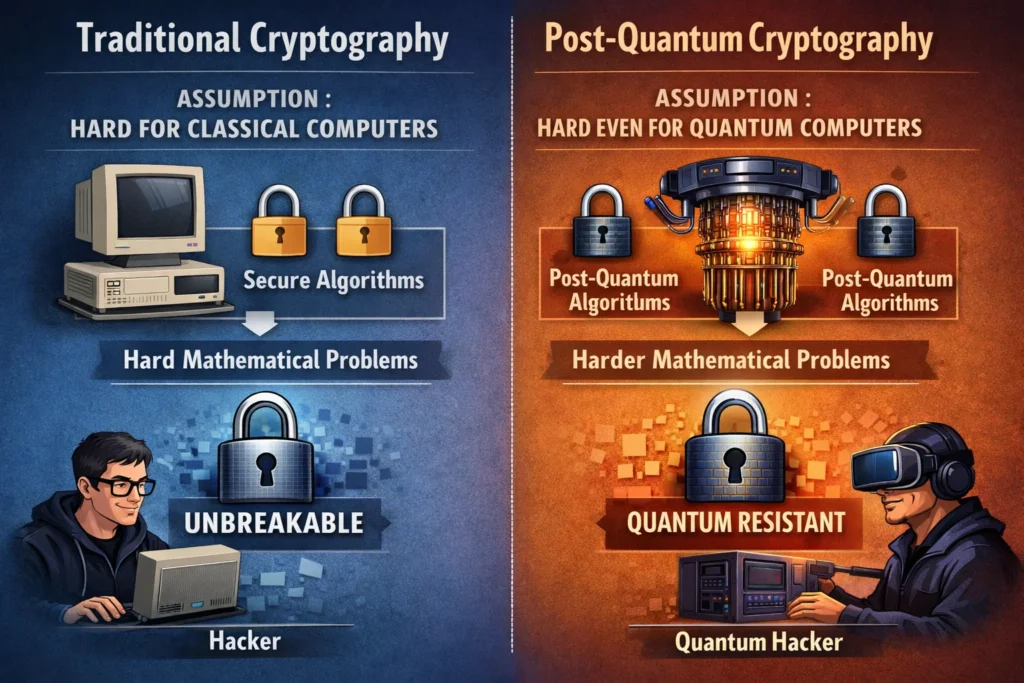
What actually changes at the algorithm level
From the outside, cryptographic APIs may look similar. Keys are generated, data is encrypted, signatures are verified. Internally, however, the mathematics is very different.
Post-quantum cryptographic algorithms typically rely on problem families such as:
- lattice-based constructions
- hash-based signatures
- code-based cryptography
These approaches trade familiarity for resilience. They are designed around problems for which no efficient quantum algorithms are currently known.
Importantly, this does not mean they are “quantum algorithms.” They run on classical hardware and can be deployed in existing systems, albeit with different performance characteristics.
What stays the same (and what doesn’t)
Despite the shift in assumptions, not everything changes.
Many core cryptographic principles remain intact:
- the need for strong key management
- the importance of secure implementations
- the role of cryptography as an enabler of trust
What does change is the confidence horizon. Traditional cryptography assumes that increasing key sizes can extend security indefinitely. Post-quantum cryptography assumes that some assumptions have a fixed lifespan.
This difference affects how systems are designed, tested, and maintained over time.
Why this is not “just another migration”
Organizations are used to cryptographic migrations. Algorithms are deprecated, new ones are adopted, certificates are rotated.
The post-quantum transition is different in three important ways.
First, the motivation is not an observed weakness, but a structural shift in computation. Second, the timelines are longer and more uncertain. Third, the consequences of delay are asymmetrical. Data exposed in the future may already be compromised today.
This makes reactive approaches risky. By the time migration becomes urgent, the systems most affected may be the hardest to change.
The role of standards and ongoing uncertainty
Institutions such as NIST have taken a cautious approach to post-quantum cryptography, running multi-year evaluation processes to select algorithms suitable for standardization.
This process reflects an important reality: post-quantum cryptography is still evolving. There is no single “best” algorithm, and trade-offs between performance, security, and implementation complexity remain.
Traditional cryptography, by contrast, operates in a much more mature and stable landscape.
How this difference affects long-term security planning
The real impact of post-quantum cryptography is not confined to cryptographic libraries. It affects how organizations think about data longevity, system lifecycles, and risk.
If cryptographic assumptions are expected to expire, systems must be designed with change in mind. This is where concepts such as cryptographic agility become central.
Preparing for post-quantum cryptography is therefore less about swapping algorithms and more about questioning where cryptography is embedded and how difficult it will be to change later.
At Secrets Vault, we focus on protecting information that retains its value over time: secrets, credentials, access data, and critical digital assets. In that context, the difference between traditional and post-quantum cryptography is not academic.
Systems designed under assumptions that are expected to expire create long-term exposure. Understanding what really changes with post-quantum cryptography helps explain why long-term security requires architectures that anticipate evolution rather than assume permanence.
Looking past terminology
It is tempting to treat post-quantum cryptography as a branding exercise or a distant concern. In reality, it represents a deeper shift in how security assumptions are evaluated.
Traditional cryptography is built on confidence in time-based hardness. Post-quantum cryptography is built on acceptance of uncertainty and change.
For organizations planning systems meant to last, that difference matters more than the algorithms themselves.