
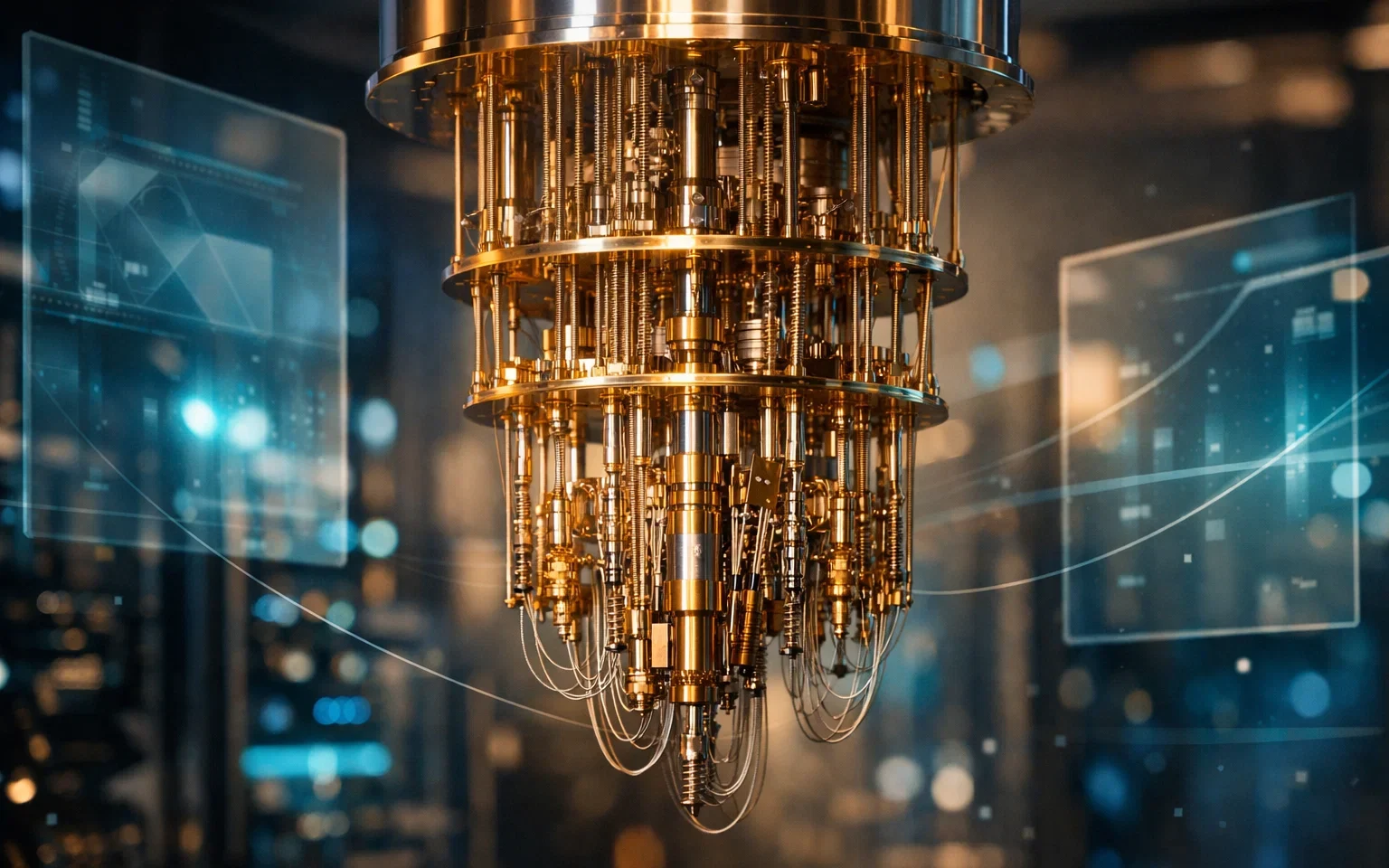
What is a quantum computer and why it breaks modern cryptography
For most of the last thirty years, cryptography has relied on a relatively stable assumption: computers are powerful, but not powerful in the right way to break the mathematics that protect modern systems. This assumption is so deeply embedded in digital infrastructure that it is rarely questioned outside academic circles.
Quantum computing forces that question back onto the table.
Long before quantum computers are deployed at scale, governments, standards bodies and security agencies have been warning that the mathematical foundations of modern cryptography will not survive the transition. Understanding why requires moving past the idea that quantum computers are simply “faster machines” and looking instead at how they compute in fundamentally different ways.
Cryptography is built on computational limits, not secrecy
Modern cryptography does not depend on keeping algorithms secret. In fact, the opposite is true. Cryptographic systems are designed under the assumption that attackers know exactly how they work.
What keeps them secure is the cost of computation.
Public-key algorithms such as RSA and elliptic curve cryptography rely on mathematical problems that are easy to compute in one direction and extremely hard to reverse. A classical computer can perform the forward operation efficiently, but reversing it would take an impractical amount of time.
Security, in this sense, is not absolute. It is economic. An attack is considered infeasible because it would take too long or cost too much.
This assumption has held remarkably well for decades.
What “quantum” actually means in computing terms
Quantum computing does not replace classical computing. It introduces a different model of computation, optimized for specific types of problems.
Classical computers process information sequentially. Even when parallelized, they still evaluate possibilities one after another. Quantum computers operate on quantum states that can represent multiple possibilities simultaneously. This allows quantum algorithms to explore certain problem spaces far more efficiently than classical algorithms ever could.
The key distinction is not speed in general, but structure. Quantum computers excel at problems that have particular mathematical properties. Unfortunately for cryptography, many cryptographic problems fall into that category.
What a quantum computer is, and what it is not
A quantum computer is not a general-purpose replacement for today’s systems. It is fragile, specialized and difficult to scale. For most business workloads, classical computers will remain dominant for the foreseeable future.
However, quantum computers are exceptionally good at solving specific mathematical problems related to factorization and discrete logarithms. These problems are not random. They are precisely the problems that underpin widely deployed cryptographic systems.
This is why institutions such as NIST and the NSA began warning about cryptographic vulnerability to quantum attacks years before functional quantum computers existed.
Why public-key cryptography is especially exposed
Public-key cryptography underpins nearly everything that requires trust on the internet. It enables secure key exchange, digital signatures, certificates and identity verification.
Algorithms such as RSA and elliptic curve cryptography were designed with classical attackers in mind. Their security depends on the assumption that reversing certain mathematical operations is computationally infeasible.
Quantum algorithms challenge that assumption directly. Once a sufficiently capable quantum computer exists, those operations become tractable. This does not weaken cryptography gradually. It breaks it decisively.
This is why increasing key sizes is not a solution. The problem is not insufficient complexity, but the collapse of the underlying hardness assumption.
Why this is a structural break, not an incremental one
Security teams are accustomed to incremental change. Algorithms are upgraded. Key sizes are increased. Systems are patched.
Quantum computing does not fit that pattern.
The threat is structural. It changes the class of problems that are computationally feasible. That means cryptographic systems designed under classical assumptions cannot be fixed through incremental adjustments.
This is also why waiting for a clear“quantum moment” is dangerous. By the time cryptographic failures are observable in the wild, sensitive data may already have been compromised.
What governments and standards bodies have been saying
The risk posed by quantum computing is not speculative. Standards bodies have been explicit about it.
NIST has been running a multi-year post-quantum cryptography standardization process precisely because existing algorithms are expected to fail under quantum attack. ENISA has published guidance warning organizations about long-term confidentiality risks. Intelligence agencies have repeatedly highlighted the need to prepare early for cryptographic transition.
The common theme across these sources is time. Cryptographic transitions take years, not months. Systems designed today will still be in use when quantum threats become real.
Why this matters for post-quantum cryptography
Post-quantum cryptography exists because the threat model has changed. It assumes attackers may eventually have access to quantum computing capabilities, and designs cryptographic systems that remain secure under those conditions.
Understanding what a quantum computer is and why it breaks modern cryptography is essential to understanding why post-quantum cryptography is not a niche concern. It is a response to a fundamental shift in computational assumptions.