
Quantum migration explained: why post-quantum cryptography is not a one-time upgrade
When post-quantum cryptography is discussed inside organizations, it is often framed as a future upgrade. A moment when algorithms are replaced, systems are updated, and the problem is considered solved.
That framing is convenient. It is also misleading.
The transition to post-quantum cryptography is not a single event. It is a long-term migration, shaped by uncertainty, system lifecycles, and the reality that cryptographic assumptions do not change all at once.
For organizations that rely on cryptography to protect sensitive data over time, understanding this difference is critical.
Why “quantum migration” is a better term than “quantum upgrade”
Calling post-quantum cryptography an upgrade suggests a discrete action. Something that can be scheduled, executed, and completed.
In reality, quantum migration behaves much more like a structural transition.
Cryptography is embedded deep inside systems: authentication protocols, identity frameworks, key management processes, compliance controls, and third-party integrations. Replacing algorithms in one layer does not automatically update the others.
A migration acknowledges that cryptography evolves unevenly, across systems with different lifespans and different risk profiles.
Cryptography does not live in isolation
One of the reasons quantum migration is often underestimated is that cryptography is treated as a technical component rather than an architectural dependency.
In practice, cryptographic assumptions shape:
- how identities are verified
- how trust is established between systems
- how data is stored and protected
- how recovery mechanisms are designed
Changing those assumptions affects far more than encryption libraries. It affects how systems behave under stress, how failures propagate, and how long data remains protected.
A one-time upgrade cannot address these dependencies.
The time dimension most migrations ignore
Traditional security planning focuses on present threats. Quantum migration forces organizations to consider time itself as a risk factor.
Some data needs to remain confidential for decades. Some systems are expected to run unchanged for years. Some cryptographic decisions, once deployed, are extremely difficult to reverse.
This is why models such as harvest now, decrypt later matter. Data encrypted today may be secure now, but exposed later, when cryptographic assumptions change.
Quantum migration is therefore not about reacting to a future event. It is about managing long-term exposure created by decisions made today.
Why parallel cryptographic worlds are unavoidable
One of the least intuitive aspects of quantum migration is that it will not happen uniformly.
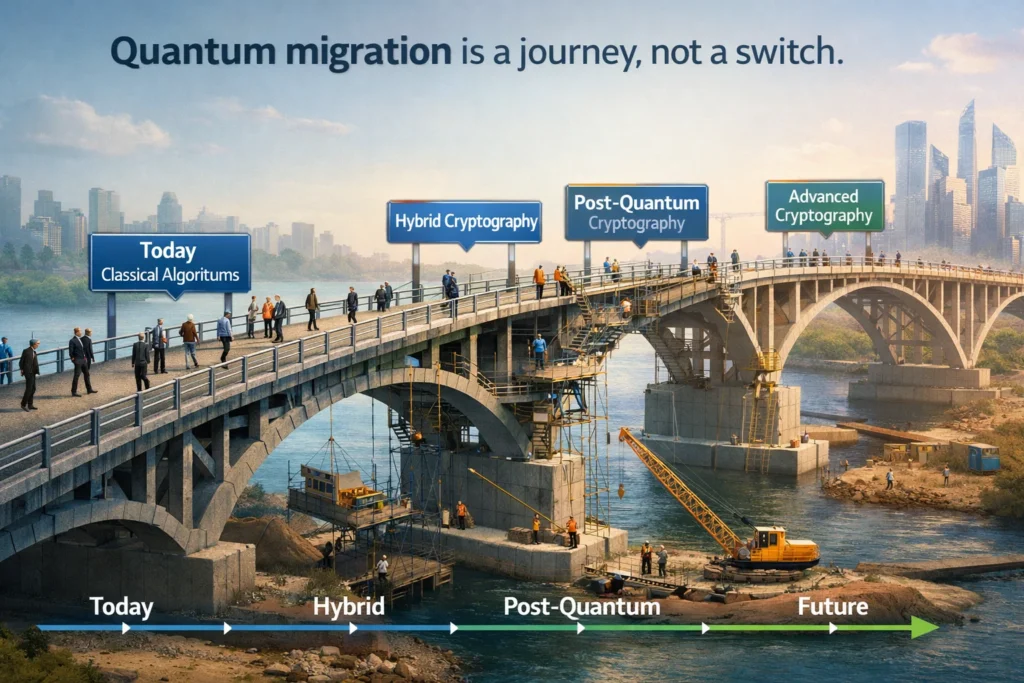
For a long period of time, organizations will operate in parallel cryptographic worlds:
- traditional cryptography for legacy systems
- post-quantum cryptography for high-risk or long-lived data
- hybrid approaches where both coexist
This coexistence is not a failure of planning. It is a practical necessity.
Standards evolve gradually. Implementations mature at different speeds. Regulatory guidance lags behind technical capability. Expecting a clean cutover ignores how complex systems actually change.
The role of standards without over-relying on them
Standardization bodies such as NIST play a crucial role in post-quantum cryptography. They provide evaluated algorithms and reduce fragmentation.
However, standards do not define migration strategies.
They do not decide:
- which systems should migrate first
- how to manage coexistence
- how to handle long-term secrets
- how to redesign trust models
Organizations that wait for standards to “solve” quantum migration risk deferring decisions that are inherently architectural and contextual.
Migration is as much about architecture as algorithms
It is tempting to focus quantum migration discussions on algorithms. Which ones are standardized. Which ones perform better. Which ones are safest.
Those questions matter. They are not the hardest part.
The real challenge is architectural:
- Where is cryptography deeply embedded?
- Which systems will be hardest to change later?
- Which data creates the most long-term exposure?
- How resilient are authentication and recovery paths?
Organizations that approach quantum migration as an architectural exercise are better positioned than those who treat it as a cryptographic swap.
Why waiting creates irreversible decisions
One of the most underestimated risks in quantum migration is option loss.
Systems designed today may still be operating when post-quantum transitions become urgent. If they are built on rigid assumptions, retrofitting cryptographic agility later may be impractical or impossible.
Waiting for certainty is not neutral. It actively narrows future choices.
Early preparation does not mean immediate deployment. It means designing systems that can evolve when needed.
At Secrets Vault, we focus on protecting information whose value persists over time: secrets, credentials, access data, and critical digital assets.
In that context, quantum migration is not a future technical concern. It is a present design constraint.
Systems that assume cryptographic permanence create long-term exposure that cannot always be mitigated later. Post-quantum cryptography reinforces a principle that already shapes our approach: security systems must be designed to evolve, not to remain unchanged.
Migration is a process, not a milestone
The biggest mistake organizations make about post-quantum cryptography is treating it as a box to be checked.
Quantum migration is not about being “done”.
It is about being prepared.
Prepared to operate in mixed environments.
Prepared to update assumptions.
Prepared to protect data whose lifespan exceeds current cryptographic confidence.
In a world where security assumptions always expire, migration is not a one-time upgrade. It is an ongoing responsibility.