

Post-Quantum Cryptography: what it is, why it matters, and how organizations should prepare
Modern organizations rely on cryptography every single day, often without realizing it. From secure communications and digital identities to data protection and trust on the internet, cryptographic systems form the invisible foundation of today’s digital world. As long as these systems work as expected, they tend to fade into the background.
Post-quantum cryptography challenges that assumption. As progress in quantum computing accelerates, organizations are being forced to reassess some of the most fundamental principles behind modern cybersecurity. Encryption systems that are considered secure today will not remain secure indefinitely, and for many types of data, that timeline matters more than it may initially appear.
This article explains post-quantum cryptography from first principles. It starts with what cryptography protects today, explains what quantum computing really changes, and then shows how organizations can begin preparing in a realistic and structured way.
Cryptography today: what it protects and why it works
What modern cryptography protects
Cryptography is not a single technology, but a set of mechanisms that enable trust in digital systems. In practice, it protects:
- Secure communications, such as TLS connections, VPNs and encrypted messaging
- Digital identities and authentication, including certificates, signatures and access control
- Data at rest, from databases and backups to archives and cloud storage
- Digital trust, such as software updates, document signing and integrity checks
Without cryptography, confidentiality, authenticity and integrity simply do not exist at scale.
The assumptions behind today’s cryptography
Modern cryptography is built on a simple idea: some mathematical problems are extremely hard to solve with classical computers. Encryption and digital signatures rely on this asymmetry. It is easy to perform an operation in one direction, but infeasible to reverse it within a reasonable amount of time.
Crucially, security is not based on something being impossible in theory, but on it being impractical in practice. Time and computational cost are what make cryptography work.
These assumptions have held for decades. Post-quantum cryptography exists precisely because quantum computing challenges them.
Quantum computing explained from first principles
What “quantum” actually means, without physics
In simple terms, quantum computing uses properties of quantum mechanics to process information differently from classical computers. Instead of working with bits that are either zero or one, quantum systems work with quantum states that can represent multiple possibilities at once.
The key point is not speed, but how problems are explored. A quantum computer can evaluate certain classes of problems in ways that classical machines fundamentally cannot.
What is a quantum computer and why it is different
A quantum computer is not a faster version of a traditional computer. It is a different type of machine designed to solve specific problems more efficiently. For most everyday tasks, classical computers remain superior.
However, for certain mathematical problems, especially those related to factorization and discrete logarithms, quantum algorithms offer dramatic advantages. These are precisely the problems on which much of today’s public-key cryptography depends.
This difference is what makes quantum computing a structural challenge for cryptography.
Why quantum computers break today’s cryptography
Why public-key cryptography is especially vulnerable
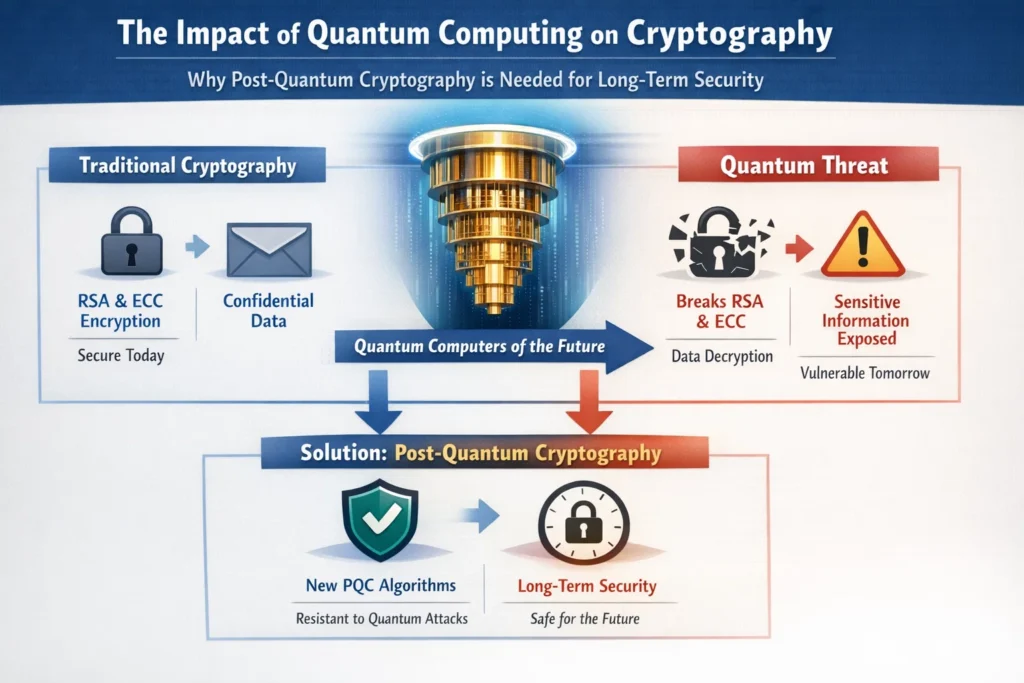
Public-key cryptography underpins key exchange and digital signatures across the internet. Algorithms such as RSA and elliptic curve cryptography are widely deployed because they are efficient and secure against classical attacks.
Quantum algorithms are expected to break these schemes by solving their underlying mathematical problems far more efficiently than classical computers ever could. Once a sufficiently powerful quantum computer exists, the security guarantees of these algorithms no longer hold.
Why this is a structural, not incremental, problem
This is not a matter of increasing key sizes or adding more computing power. The problem is structural. The mathematical hardness that once guaranteed security no longer applies under a quantum threat model.
This is why post-quantum cryptography is not an optimization of existing systems, but a replacement of the assumptions on which they rest.
What post-quantum cryptography really is (and is not)
A clear definition of post-quantum cryptography
Post-quantum cryptography refers to cryptographic algorithms designed to remain secure even against attackers equipped with powerful quantum computers. These algorithms run on classical systems, but rely on mathematical problems that are believed to resist quantum attacks.
The goal of post-quantum cryptography is continuity of security in a world where traditional assumptions no longer apply.
What post-quantum cryptography is not
Post-quantum cryptography is often misunderstood. It is:
- Not quantum cryptography, which relies on specialized quantum hardware
- Not an automatic upgrade, where one algorithm is simply replaced everywhere
- Not a future-only concern, disconnected from today’s security decisions
It is a long-term response to a changing threat landscape.
Why this is already a problem: harvest now, decrypt later
How harvest now, decrypt later works
One of the most critical implications of quantum risk is the strategy known as harvest now, decrypt later. Attackers can collect encrypted data today and store it until quantum capabilities make decryption possible.
From a security perspective, this means confidentiality can be lost retroactively, long after data was assumed to be safe.
Which data is most exposed
Not all data carries the same risk. The most exposed information includes:
- Personal or regulated data with long retention requirements
- Intellectual property and trade secrets
- Identity-related data and credentials
- Legal, financial or contractual records
For this type of data, waiting until Q-Day to act is not a viable strategy.
How post-quantum cryptography works, without the math
Families of post-quantum algorithms
Post-quantum cryptography is not a single algorithm. It consists of several families, each based on different mathematical problems:
- Lattice-based cryptography, currently the most prominent and widely standardized approach
- Hash-based cryptography, mainly used for digital signatures
- Code-based cryptography, relying on error-correcting codes
- Multivariate cryptography, based on systems of polynomial equations
Each family comes with different performance, size and implementation trade-offs, which is why multiple approaches coexist.
What these algorithms are used for
Like classical cryptography, post-quantum algorithms are applied to:
- Key exchange mechanisms
- Encryption schemes
- Digital signature systems
What changes is not the function, but the resilience of the underlying assumptions.
Standardization, NIST, and what it really means for organizations
The role of NIST in post-quantum cryptography
The National Institute of Standards and Technology (NIST) plays a central role in standardizing post-quantum cryptography. Through a multi-year, open and highly scrutinized process, NIST evaluates candidate algorithms and selects those suitable for widespread adoption.
Several algorithms have already been selected, while formal standards continue to evolve. This evolution is expected and reflects the maturity process of cryptographic technologies.
What NIST defines and what it does not
NIST defines cryptographic algorithms and technical standards. It does not define how organizations should redesign architectures, migrate systems or manage cryptographic dependencies in production environments.
This distinction is critical. Standards provide building blocks, but organizations must decide how and when to use them as part of a broader quantum migration strategy.
Quantum migration in the real world
Which systems will be affected
Quantum migration impacts many layers of modern infrastructure, including:
- Public key infrastructures and digital certificates
- Secure communication protocols such as TLS
- Identity and authentication systems
- Long-term data protection, backups and archives
These dependencies are often deeply embedded and not always visible.
Why quantum migration is a long-term process
Quantum migration is not a single event. Classical and post-quantum algorithms will coexist for years. This requires cryptographic agility, meaning systems must be designed to evolve as standards mature.
Common mistakes include delaying preparation, hard-coding cryptographic choices, or assuming migration will be quick once standards are finalized.
How organizations should start preparing today
Practical first steps
Organizations do not need to migrate everything immediately. Practical preparation includes:
- Inventorying where cryptography is used across systems
- Identifying data that requires long-term confidentiality
- Avoiding irreversible cryptographic decisions in new projects
- Designing systems that can evolve as post-quantum standards mature
These steps reduce future risk without introducing unnecessary disruption.
Post-quantum cryptography as a strategic decision
Post-quantum cryptography is not about reacting to hype or predicting exact timelines. It is about recognizing that cryptographic assumptions have a lifespan, and that some data must remain secure far beyond that lifespan.
Organizations that start preparing early gain time, flexibility and control. Those that wait until quantum threats become imminent may find themselves forced into rushed migrations with lasting consequences.
This is exactly the type of long-term security challenge modern organizations face. At Secrets Vault, we approach it by designing architectures that prioritize resilience, adaptability and long-term protection, helping organizations prepare for what comes next without compromising security or usability today.