Long-term data confidentiality in a post-quantum world
For years, data protection strategies have been built around a relatively simple objective: prevent unauthorized access today. Firewalls, access controls, encryption and monitoring systems are designed to stop breaches in the present tense. If data remains unreadable now, it is considered secure.
Quantum computing complicates that assumption.
The challenge introduced by quantum technologies is not limited to how data is accessed, but to how long data must remain confidential. In a post-quantum context, protecting information is no longer just about defending against current attackers. It is about ensuring that sensitive data cannot be exposed years or decades after it was created.
This shift forces organizations to rethink what long-term confidentiality actually means.
Data protection versus confidentiality longevity
Data protection and confidentiality are often treated as interchangeable concepts. In practice, they are not the same.
Data protection focuses on controlling access. It asks who can read, modify or delete information today. Confidentiality longevity asks a different question: will this data still be unreadable in the future, even if security assumptions change?
For short-lived operational data, these questions often overlap. For long-lived sensitive data, they diverge sharply.
Records that must remain confidential for many years include personal data governed by regulation, legal and financial documentation, intellectual property and sensitive business information. For this data, time itself becomes a threat vector.
Why encryption alone is no longer sufficient
Encryption is frequently described as the final safeguard for sensitive data. Once data is encrypted, it is assumed to be protected regardless of where it is stored.
This assumption holds only as long as the cryptographic algorithms used remain secure. Quantum computing challenges that premise by introducing a future point at which widely used encryption methods may no longer provide confidentiality.
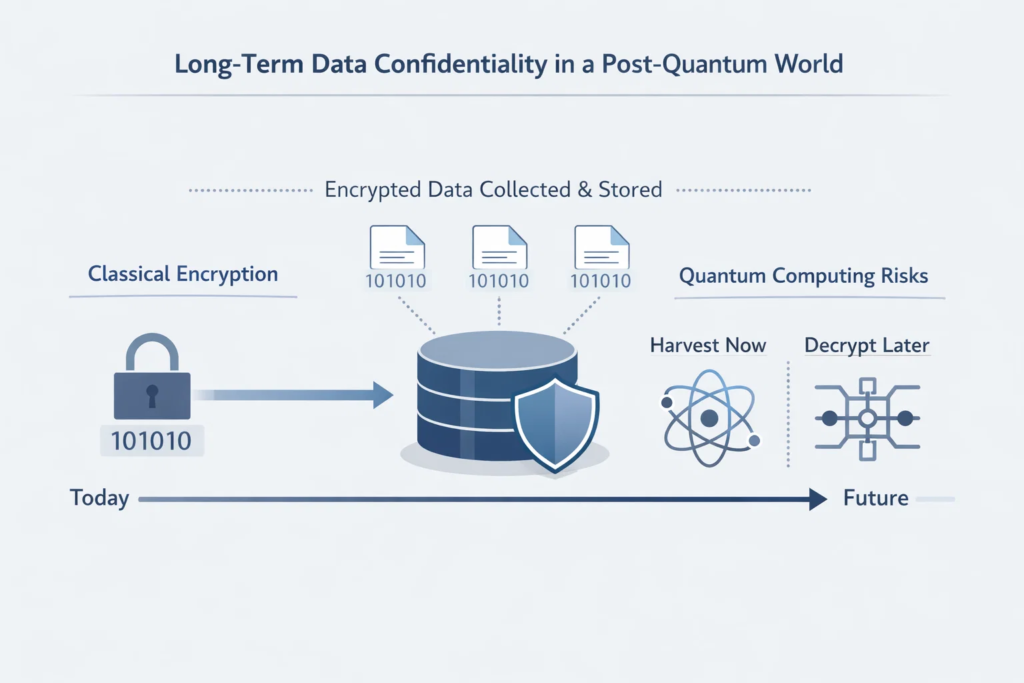
The issue is not that encryption suddenly stops working overnight. It is that encrypted data captured today may be decrypted later, once cryptographic assumptions fail. This is the core of the harvest now, decrypt later threat model highlighted by standards bodies such as NIST and ENISA.
For data with long retention requirements, encryption must therefore be evaluated over its entire expected lifespan, not just at the moment it is applied.
How long-term confidentiality becomes a business risk
Long-term confidentiality is often framed as a technical concern. In reality, it has direct business implications.
Regulatory exposure is one example. Many data protection regulations require organizations to safeguard personal data over extended periods. If encrypted data is exposed years later due to cryptographic failure, the organization remains accountable.
Intellectual property represents another category. Trade secrets, designs and proprietary processes may retain value far longer than the cryptographic algorithms used to protect them. A delayed breach can have strategic consequences that are difficult or impossible to reverse.
From a risk perspective, delayed exposure can be more damaging than immediate breach, precisely because it is harder to detect, attribute and remediate.
What standards bodies are warning about
Concerns around long-term confidentiality are not speculative. They are reflected in guidance from multiple institutions.
NIST has explicitly warned that organizations should consider the risk of future cryptographic compromise when protecting sensitive data. ENISA has emphasized the importance of cryptographic agility and forward-looking security design in the context of emerging technologies.
The common message across these sources is that cryptographic transitions take time. Systems designed today will still be in use when current algorithms are no longer considered secure.
This reality makes early planning essential.
Post-quantum cryptography as part of the solution
Post-quantum cryptography addresses one dimension of the long-term confidentiality problem. By using algorithms designed to resist both classical and quantum attacks, it reduces the risk that encrypted data captured today can be decrypted in the future.
However, post-quantum cryptography alone is not a complete solution. Algorithms do not operate in isolation. They are embedded in architectures, workflows and operational practices that determine how data is accessed and protected over time.
Long-term confidentiality depends as much on system design as on cryptographic primitives.
Architectural considerations for long-lived data
Protecting data over long time horizons requires architectures that assume change rather than permanence.
Key considerations include minimizing the exposure of sensitive data, limiting the distribution of decryption capabilities and ensuring that cryptographic components can be updated without redesigning entire systems.
This is where cryptographic agility becomes critical. Systems that are tightly coupled to specific algorithms or key management approaches are difficult to adapt when assumptions change.
By contrast, architectures designed to evolve can incorporate new cryptographic standards, including post-quantum algorithms, as they mature.
Why data retention policies matter more than ever
Long-term confidentiality cannot be separated from data retention decisions. The longer data is stored, the longer it must remain secure.
Many organizations retain data by default, without regularly reassessing whether it still needs to exist. In a post-quantum context, unnecessary retention increases risk without delivering value.
Re-evaluating retention policies, limiting the lifespan of sensitive data and reducing unnecessary copies are powerful tools for managing long-term confidentiality risk.
These measures complement cryptographic protections rather than replacing them.
Connecting long-term confidentiality to post-quantum migration
The move toward post-quantum cryptography is often described as a migration. In reality, it is a gradual transition that will unfold over many years.
During this transition, classical and post-quantum algorithms will coexist. Organizations that understand which data requires long-term protection can prioritize where post-quantum measures matter most.
This selective approach reduces complexity and avoids premature disruption, while still addressing the highest-risk scenarios.
At Secrets Vault, we work with information whose value does not disappear over time: secrets, credentials, access data, and critical digital assets. In that context, delayed exposure is as relevant as immediate security. Quantum computing and post-quantum cryptography are not academic discussions for us, but a natural consequence of designing systems that must remain secure as technological assumptions evolve.