
Biometric Authentication: Risks & AI in 2025
Authenticating with who we are: real convenience, real risks and a higher bar in the age of deepfakes.
From sci-fi to everyday: why biometrics isn’t magic anymore
From unlocking phones to crossing borders, the question is no longer “if,” but “when, how, and under what rules.”
Biometrics left science fiction behind to become an everyday gesture. A face opens a phone, a fingerprint authorizes a payment, a voice unlocks an account, and at the airport an iris scan clears the gate. The promise is powerful: identify with what one is, not with what one remembers. But magic has limits. Artificial intelligence, capable of manufacturing near-perfect lookalikes, moves the ground under biometrics: it sharpens accuracy while enabling ever more convincing impersonations. In this landscape, the real question is not whether biometrics should be used, but when, how, and under which safeguards.
Biometrics in 2025: the map and the momentum
Morphological, behavioral, and biological; from one-off checks to continuous authentication, with privacy at the center.
Today’s ecosystem spans three broad families:
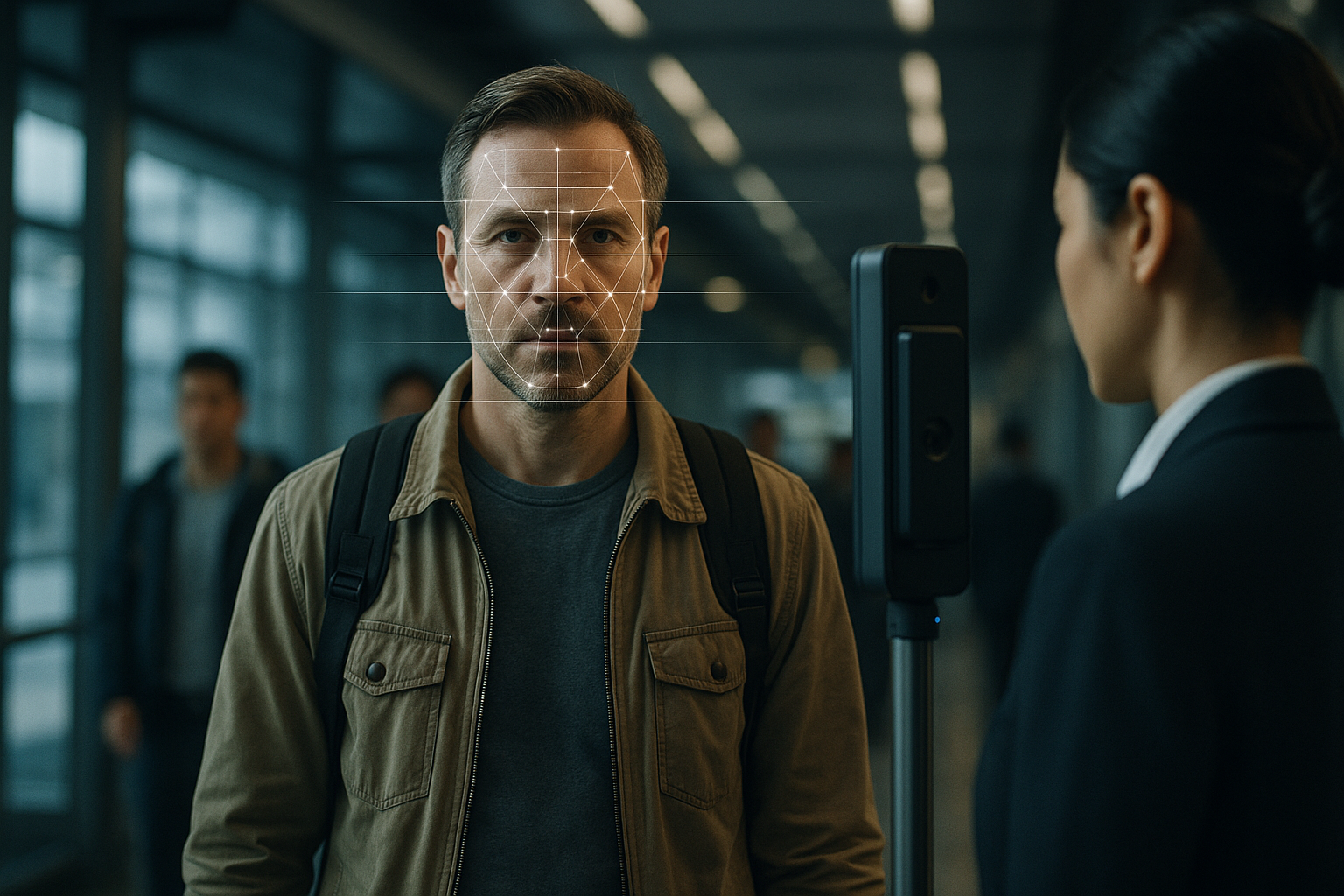
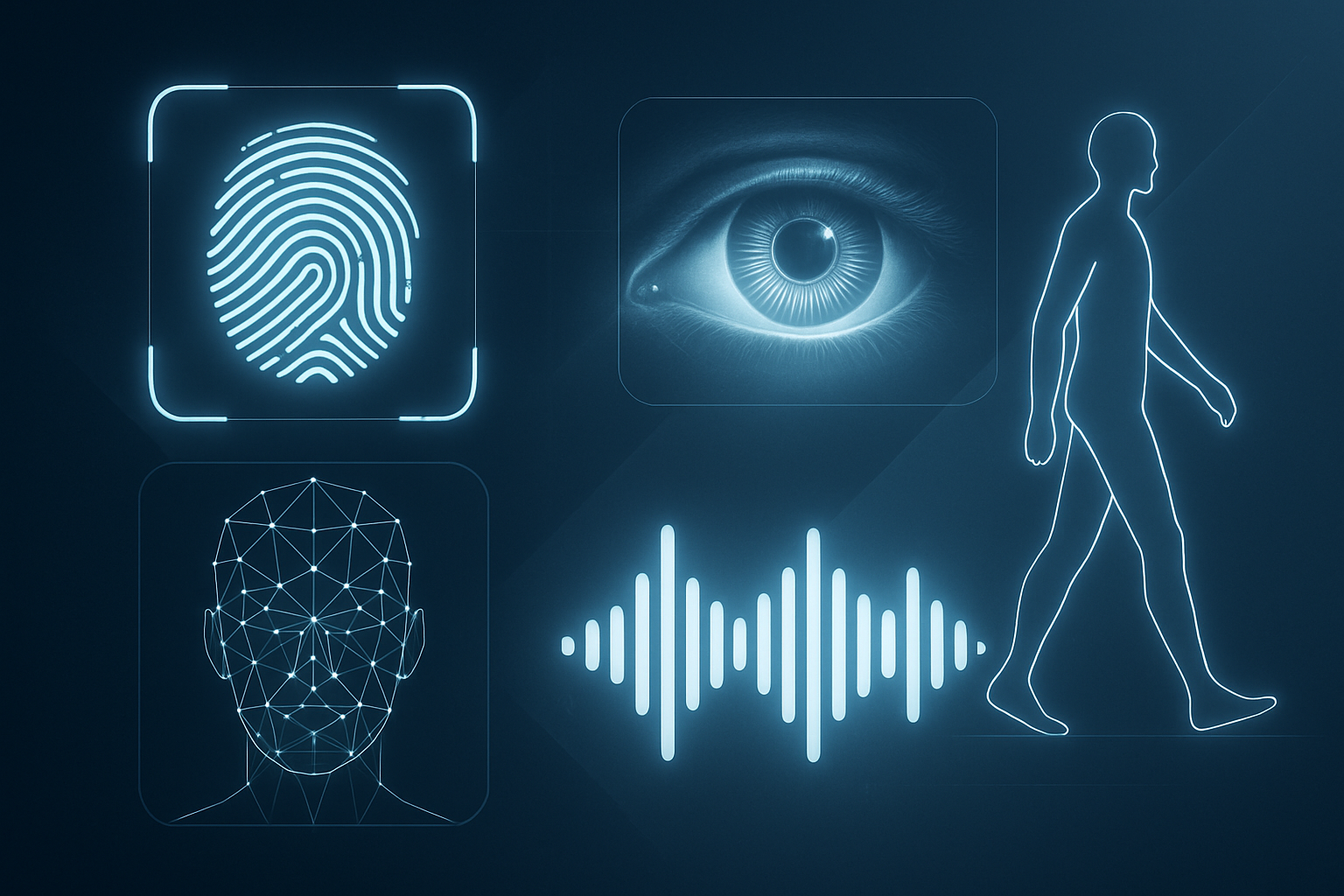
- Morphological biometrics rely on visible or measurable traits, fingerprint, 2D/3D face, iris, vein patterns, dominant in mobiles, banking, physical access, and border control for their balance of speed and reliability.
- Behavioral biometrics read patterns in use and movement, keystroke dynamics, mouse rhythm, dynamic signature, gait, even vocal cadence, pushing the shift from a single checkpoint to continuous authentication that accompanies a session and flags anomalies in real time.
- Biological biometrics at genetic or molecular level have a more limited everyday role due to legal, ethical, and operational constraints.
Use cases multiply across eKYC onboarding, transaction authorization, secure facilities, streamlined airport flows, and fraud control in remote channels. Three currents define the moment: multimodality to combine signals and raise robustness; continuous verification to curb fraud without extra friction; and a growing emphasis on privacy, privileging on-device processing and offering credible non-biometric alternatives.
Under the hood: how it works without drowning in jargon
Templates, thresholds, and liveness the essentials of a sound biometric system.
While each modality has nuances, the conceptual journey is similar. First, a sample of the trait is obtained: fingerprint, face, or a spoken phrase. Next, it is cleaned and normalized so light, angle, or noise do not dominate. From that sample, mathematical features are extracted to build a biometric template, a numerical representation of the trait; the ideal system works with this template, not with raw images or audio. The template is safeguarded and, at authentication time, a fresh representation is produced for comparison. When the check is against a single enrolled record, it is 1:1 verification (“is this person who they claim to be?”). Against many, it is 1:N identification (“who is this person in the database?”).
Quality is governed by familiar metrics. FAR measures how many improper accesses are accepted; FRR how many legitimate ones are rejected; EER is where both errors balance (the lower, the better). ROC curves help choose thresholds that trade off security and usability for each context. A crucial component is liveness detection (PAD): passive and active techniques that confirm the sample comes from a present, live human, not from a photo, mask, screen, or recording. Without solid liveness, a system that shines in the lab turns naïve in the wild.
Where the template lives: on-device, server, or hybrid
Architecture is destiny: storage location sets risk, compliance posture, and user experience.
Asking “where does the template reside?” answers much about risk. In on-device verification, the template lives inside a secure enclave on the device and matching happens locally. Exposure is minimized and privacy tends to be stronger; the trade-off is managing multiple devices per person and recovery flows after loss or replacement. In server-side models, templates are centralized and matching occurs in enterprise or provider infrastructure. This eases auditing, scale, and 1:N scenarios, yet turns the database into an attractive target and makes revocation harder if an incident occurs. Hybrid schemes aim for the best of both: local verification as a first barrier with additional validations or recovery from the server when needed.
Protecting templates requires layered defenses. Strong encryption in transit and at rest is baseline, but insufficient alone. Template protection, cancelable biometrics, revocable transformations, fuzzy extractors enables “re-issuing” representations if compromise is suspected. HSMs and enclaves help process comparisons without exposing secrets. Segmentation separates personal identifiers from templates and enforces granular access. Retention and verifiable deletion policies, plus thorough audit logging, complete the picture. It bears repeating without drama or euphemism: compromising a template is not like resetting a password; architecture must be built around that fact.
Regulatory and compliance impact of server-side biometrics
Storing or processing biometric data on a server has a major regulatory impact in many countries and requires very high security. If it is not done correctly, the risk exposure is far greater than with most other forms of personal data.
In the EU and UK, biometric data used for unique identification is defined as special-category data under GDPR. That means it is generally prohibited unless a narrow legal basis applies (such as explicit consent) and must follow strict requirements for security of processing. In practice, large-scale or high-risk deployments almost always trigger a Data Protection Impact Assessment (DPIA). Regulators also emphasize the high inherent risk of biometrics, because traits cannot be changed once compromised.
In the U.S., the Illinois Biometric Information Privacy Act (BIPA) sets some of the strictest rules: written notice and consent, public retention/deletion policies, and statutory damages of $1,000 per negligent violation or $5,000 per reckless/intentional violation. Several other states are following with similar bills.
In practice: prefer on-device matching where feasible, and treat any server-side biometric processing as a high-assurance, audited deployment, with layered controls (encryption in transit/at rest, template protection/cancelable biometrics, HSM/enclaves, tight access segmentation, short retention with verifiable deletion, comprehensive logging) and documented DPIAs where appropriate.
AI: engine of accuracy and an open door to new fraud
The same models that smooth UX also enable deepfakes, morphing, and adversarial attacks.
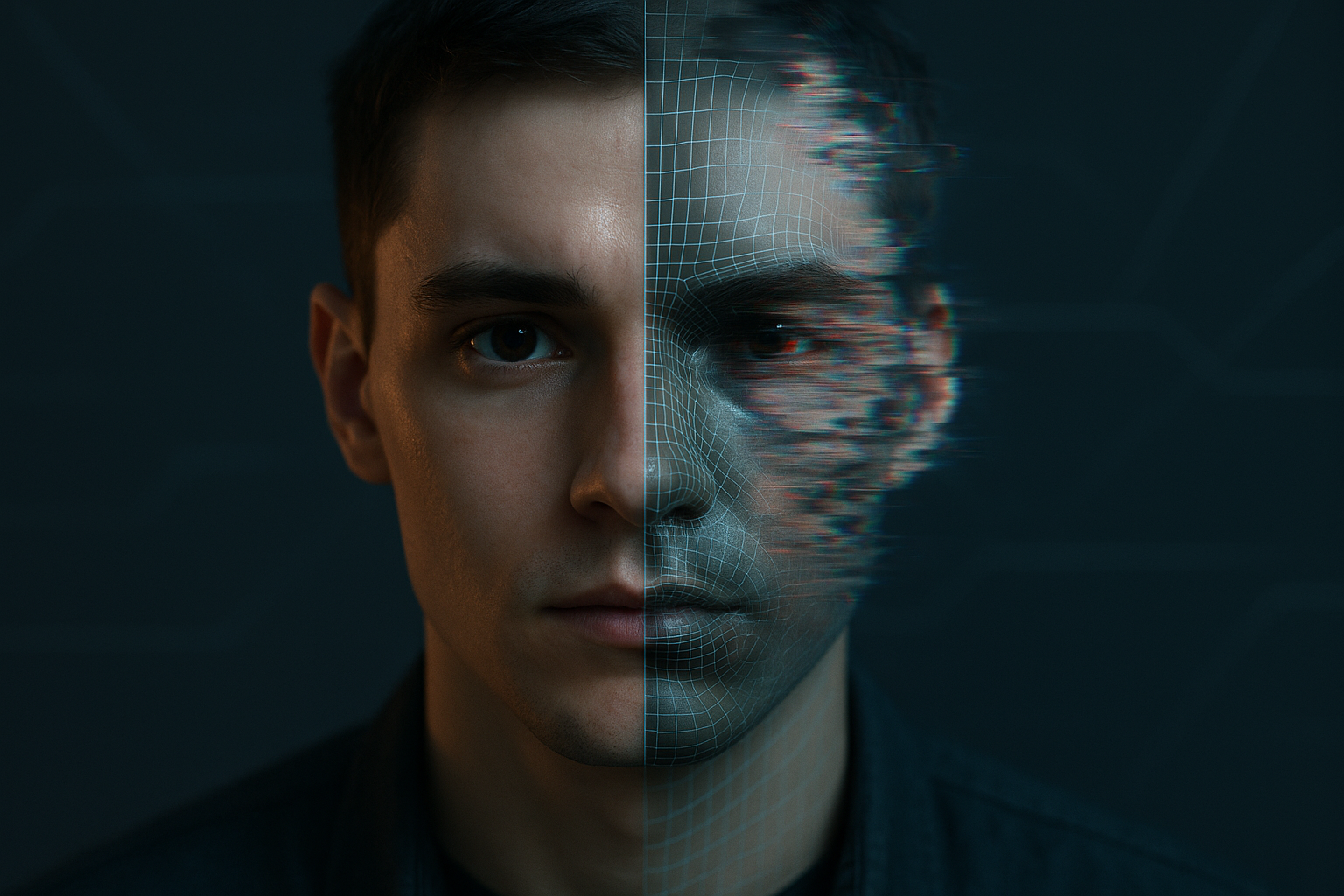
AI markedly improves biometrics. Deep embeddings represent traits with higher fidelity and withstand challenging conditions; experience gets smoother as systems tolerate variation in lighting, angles, and noise; with the right guardrails, models can learn from real use to reduce unfair rejections. At the same time, AI challenges biometrics like never before. Face and voice deepfakes, morphing that blends identities into a single image, adversarial perturbations that confuse models, and data poisoning that contaminates training sets are all part of the offensive toolkit. Add synthetic identities at industrial scale and a fundamental issue bias. Poorly diverse training yields uneven performance across groups, with technical, legal, and reputational consequences.
Meeting this double-edge requires raising the bar. Multimodality paired with robust liveness is now table stakes, capable of evaluating depth, texture, audio-lip sync, and unpredictable micro-gestures. Anti-spoof models should be trained with hard examples low resolution, varied cameras, diverse compressions and organizations need model governance: version traceability, clear documentation, equity testing, and human review in sensitive cases. Data hygiene provenance, curation, defenses against poisoning is as vital as the algorithm.
Comply and care: privacy and ethics without fine print
Real consent, data minimization, and non-biometric options as policy, not as exception.
Serious deployments start with informed consent: a purpose that is clear, comprehensible, and limited. Minimization means collecting only what is necessary and working with templates rather than raw media. Purpose limitation and bounded retention prevent opaque secondary uses and unnecessary stockpiling. In higher-risk contexts, impact assessments are not red tape but decision maps. Transparency calls for public policies and, where warranted, independent review. One non-negotiable: objection mechanisms and non-biometric alternatives that do not unfairly penalize those who choose them.
Mitigate for the real world: what actually works in production
Layers, strong liveness, template protection, and regular exercises against AI-powered threats.
Biometrics performs best as a layer in a broader strategy, not as a total replacement for everything else. Combining factors trims error surfaces without turning access into an obstacle course. Designing on-device where feasible limits exposure; if an organization needs server-side templates, template protection and HSMs are not optional. Systems should be exercised regularly against realistic offense: anti-spoof drills, deepfake scenarios, varied presentation attacks. Real-time fraud monitoring catches anomalies without slowing the majority. Above all, user experience leads: explain what is done, why, and how it is protected; provide alternative paths; ensure human support; measure help-desk impact; adjust without blaming people who simply need access.
Before rollout: the adoption checklist, narrated
Risk, modality, architecture, revocation, AI defenses, and operational metrics, the essentials.
Practical rollouts benefit from order. First, define the specific risk to be reduced and where it appears along the user journey. Second, choose modality and architecture for the context, avoiding a face-first reflex where voice or behavioral would fit better. Third, decide how the template will be protected and, if needed, re-issued; no plan is complete without an exit. Fourth, prepare defenses against AI-driven attacks, the level of liveness, deepfake detection, adversarial testing. Fifth, agree on operational metrics (FAR, FRR, EER, latency, help-desk impact) and review them across population segments to surface bias. Sixth, secure privacy and compliance through minimization, bounded retention, access logs, and audits. Finally, maintain reasonable non-biometric alternatives so security remains an enabler, not a barrier.
From “who we are” to “what we can safely use”
There’s a second path forward: biometric-level convenience without storing anyone’s body. A visual, device-first factor that transforms familiar images into cryptographic challenges, run locally, with no templates on the server, and keys that can be revoked, rotated, and re-issued like credentials. Because the factor isn’t a bodily trait, it preserves privacy by design and avoids the lifelong risk of leaked biometrics.
In practice, this complements or even replaces passwords: a passwordless front door that’s MFA-friendly, a step-up when liveness fails, or a fallback that reduces help-desk pain without sacrificing assurance. With post-quantum–ready primitives and per-device derivations, what travels is a proof, not the secret, and recovery doesn’t require collecting more of a person.
If the goal is to raise security without collecting more of the human, the direction is clear: image-based, on-device authentication, revocable by design, privacy-first, and built for modern IAM.
Field glossary
The terms that keep conversations, and contracts, grounded.
- Template: numerical representation of a biometric trait; not a raw image or recording.
- 1:1 / 1:N: verification against a single record vs. identification against many.
- FAR / FRR: rates of improper acceptance and improper rejection.
- EER: the balance point of both errors, useful for system comparison.
- ROC: curve for picking the right threshold per context.
- Liveness / PAD: tests that confirm a present, live human source.
- Cancelable biometrics: template transformations that allow revocation and re-issuance.
- Deepfake / morphing: AI-generated impersonations and blended identities.
- Adversarial attack: minimal perturbation crafted to fool a model.